Donadiu
Solapas principales
Según apunta Sam Colop (nota 390, página 259): "Tonatiuh conforme al diccionario de Karttunen (1992) quiere decir 'el Sol' y nos refiere a tóna que quiere decir 'hacer calor o Sol'. Probablemente, el sobrenombre de Pedro de Alvarado no se refiera al color de su cabello, como tradicionalmente se ha dicho, sino a su práctica de 'quemar' a sus víctimas".
Christenson (2007: nota 857, página 278) nota la conflación de los sonidos “T” y “D” en el nombre que Ximénez escribe como “Tonatiuh,” o “Don Alvarado” en ortografía española moderna. El escribe: “Donadiu (o Tonatiu) era el nombre dado a Don Pedro de Alvarado, el capitán español de Hernán Cortes quien conquistó la región Maya de las tierras altas de lo que hoy es Guatemala. Esta es la versión K’iche’ Maya de Tonatiuh (Nahua para el ‘sol, calor’), el nombre de cual Alvarado era conocido por los Aztecas y sus mercenarios Tlaxcaltecas. Probablemente recibió este apodo por su pelo rubio, una característica física desconocida en el Nuevo Mundo Precolombino (además de albinos, quienes todavía son llamados ‘niños del sol’ en muchas comunidades K’iche’). El nombre puede haber tenido más importancia para los K’iche’, sin embargo. Más temprano en el texto Popol Vuh, la apariencia de un sol nuevo representaba la muerte del mundo viejo y el establecimiento de un poder político nuevo y sancionado divinamente. Alvarado como el ‘sol’ nuevo destruye el mundo viejo y sus dioses inauguran a una época nueva. Por esta razón, Jesús Cristo como la deidad patrona recién establecida se equipará con el sol a través del mundo Maya (La Farge y Byers 1931, 113-114; La Farge 1947, 104; Mace 1970, 24; Thompson 1970, 234; Vogt 1970, 4; Morley et al. 1983, 465; Cook 1986, 140, 148; Tarn y Prechtel 1986, 174, 180-181; Freidel et al. 1993, 292; Cook 2000, 215-219).”
Tales lecturas sincréticas del pasado no son limitadas a Santa Cruz del K’iche’. Christenson (2007: nota 857, página 278) continúa, “En Jacaltenango, hay un mito para la fundación del pueblo en cual el nacimiento de Cristo está asociado con la primera salida del sol cuyos rayos matan a sus enemigos que tratan de esconderse en las cavernas y debajo del agua. La Farge y Byers sugieren que este mito es una versión sincretizada del relato del amanecer en el Popol Vuh, que también terminó la época previa y convirtió a sus habitantes en piedra (La Farge y Byers 1931, 113-114).”
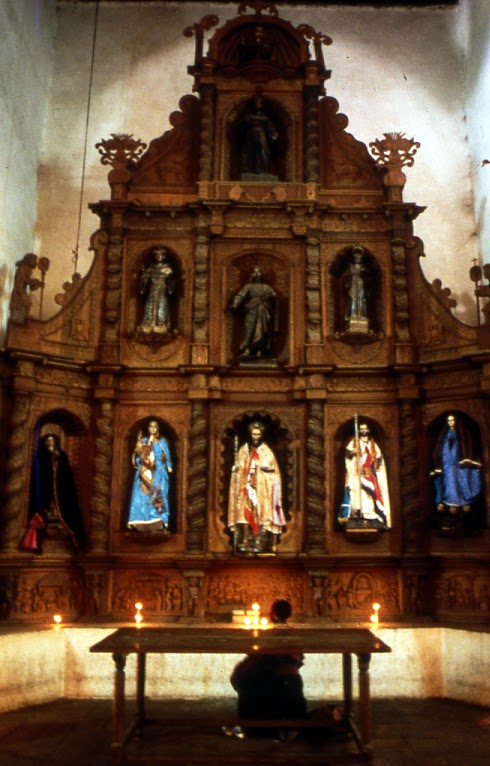
En Santiago Atitlán, escultores Maya tallaron un buque con el sol a los lados izquierda y derecha del retablo de la iglesia principal del pueblo, la cual se asentó en la época colonial. En su explicación de los buques de sol, uno de los escultores, Diego Chávez Petzey, dijo que el sol en la izquierda representa una tortilla, porque el maíz es el ‘sol’ de los Maya. El sol en la derecha es el Anfitrión eucarístico cristiano. Continuó diciendo que la vida no puede existir sin sacrifico. El maíz debe ser aplastado en una piedra de moler antes de que se pueda convertir en la tortilla. El trigo en el Anfitrión sacramental también debe ser molido y horneado. El sol solamente puede subir en el este después de que haya sido enterrado en el oeste: ‘Tortillas, el Anfitrión, Jesús Cristo y el sol dan vida porque son los primeros matados. Las tortillas y el pan resultan de la muerte del maíz y trigo para que nos puedan dar vida. Por lo tanto, ellos son dioses.’ Nicolás Cháves Sojuel, que también trabajó en las tallas de retablo, me dijo que cuando los españoles vinieron, la tierra se murió junto con los dioses antiguos y los reyes. Cuando le pregunté cómo el mundo se pudiera morir, él dijo: ‘La tierra se ha muerto muchas veces. Cada vez el mundo y sus dioses son renacidos a una vida nueva y recuperan su antiguo poder y dioses nuevos son añadidos… Los santos hoy tienen nombres españoles porque la tierra vieja murió en los días de los conquistadores españoles. Cuando los guardianes del espíritu del mundo aparecieron otra vez eran santos, pero hacen el mismo trabajo que los dioses viejos hacían antiguamente’ (Christenson 2001, 135).”
Christenson (2007: note 857, page 278) also notes the conflation of "T" and "D" sounds in the name that Ximénez writes as "Tonatiuh", or "Don Alvarado" in modern Spanish orthography. He writes: "Donadiu (or Tonatiu) was the name given to Don Pedro de Alvarado, the Spanish captain of Hernán Cortés who conquered the highland Maya region of what is today Guatemala. This is the Quiché Maya version of Tonatiuh (Nahua for 'sun, heat'), the name by which Alvarado was known to the Aztecs and his Tlaxcalan mercenaries. He likely received this nickname because of his blonde hair, a physical trait unknown in the Precolumbian New World (other than albinos, which are still called 'children of the sun' in many Quiché communities). The name may have had further significance for the Quichés, however. Earlier in the Popol Vuh text, the appearance of a new sun represented the death of the old world and the establishment of new, divinely-sanctioned political power. Alvarado as the new 'sun' destroys the old world and its gods inaugurating a new age. For this reason, Jesus Christ as the newly-established patron deity is equated with the sun throughout the Maya world (La Farge and Byers 1931, 113-114; La Farge 1947, 104; Mace 1970, 24; Thompson 1970, 234; Vogt 1970, 4; Morley et al. 1983, 465; Cook 1986, 140, 148; Tarn and Prechtel 1986, 174, 180-181; Freidel et al. 1993, 292; Cook 2000, 215-219)."
Such syncretic readings of the past are not limited to Santa Cruz del K'iche'. Christenson (2007: note 857, page 278) continues, "At Jacaltenango, there is a myth for the foundation of the town in which Christ’s birth is associated with the first rise of the sun, whose rays kill his enemies who had tried to hide in caves and under water. This allows Jacaltenango to be founded in the center of the world. La Farge and Byers suggest that this myth is a syncretized version of the account of the dawn in the Popol Vuh, which also ended the previous age and turned its inhabitants to stone (La Farge and Byers 1931, 113-114)."
"At Santiago Atitlán, Maya sculptors carved a vessel bearing a sun on the left and right sides of the community’s colonial era church altarpiece. In his explanation of the sun vessels, one of the sculptors, Diego Chávez Petzey, said that the sun on the left represents a tortilla, because maize is the Maya 'sun.' The sun on the right is the Christian eucharistic Host. He went on to say that life cannot exist without sacrifice. Maize must be crushed on a grinding stone before it can be made into tortillas. The wheat in the sacramental Host must also be ground and baked. The sun can only rise in the east after it has been buried in the west: 'Tortillas, the Host, Jesus Christ, and the sun give life because they are first killed. Tortillas and bread result from the death of maize and wheat so that they can give us life. They are therefore gods.' Nicolás Chávez Sojuel, who also worked on the altarpiece carvings, told me that when the Spaniards came the earth died along with the ancient gods and kings. When I asked him how the world could die, he replied: 'The earth has died many times. Each time the world and its gods are reborn to new life and they regain their former power and new gods are added .... The saints today have Spanish names because the old earth died in the days of the Spanish conquerors. When the spirit keepers of the world appeared again they were the saints, but they do the same work that the old gods did anciently' (Christenson 2001, 135)."